If you are trying to work out how to choose a safe AI toy, the most useful document published this year is not a review or a buying guide. It is a bill that has gone nowhere. Maryland House Bill 1261, the Artificial Intelligence Toy Safety Act, was introduced on 12 February 2026 and has been sitting in the House Economic Matters Committee ever since. Its hearing was scheduled, then canceled. As of 2 September 2026 no further action is recorded.
That sounds like a non-event. It is not, for one reason: writing a bill forces someone to be specific. Advocacy reports say AI toys are risky. A bill has to say exactly what a manufacturer must do, by when, and what happens if it does not. HB 1261 lists fifteen or so concrete obligations, and a parent standing in a shop can turn most of them into questions.
What is the Maryland AI Toy Safety Act, and where does it stand?
It is a proposed amendment to the Maryland Consumer Protection Act that would regulate any toy using machine learning, conversational AI or behavioural modelling that is marketed to or mainly used by children. Eleven Maryland delegates sponsored it, ten Democrats and one Republican. It has not passed, and it has not been voted on. It remains a proposal.
The bill's timing is what makes it worth reading. On 15 January 2026, Senators Klobuchar, Cantwell and Markey wrote to the Consumer Product Safety Commission about AI in children's toys. On 13 February the CPSC's acting chairman replied that the agency's mission has always been reasonably foreseeable risks of physical injury, and that it is neither equipped nor authorised to assess mental, emotional or psychological harm. So a state proposed pre-market rules, and the federal regulator confirmed the gap those rules were written to fill.
What would the bill actually require of manufacturers?
Fifteen obligations, grouped into four areas: proving the toy is safe before it is sold, limiting what data is taken from the child, controlling what the toy is allowed to say, and controlling how it is allowed to be advertised. Existing toys on the market as of 1 July 2026 would have had until 1 January 2027 to complete a first safety assessment.
| Area | What HB 1261 would require | The question it becomes for a parent |
|---|---|---|
| Before sale | A documented child safety assessment covering foreseeable risks and mitigations, plus a clear label saying the toy uses AI and what data it collects | Can the maker show me a written safety assessment, and does the box say what the toy collects? |
| Data collected | Only the minimum needed for core function, encrypted, never sold or transferred, never used to train unrelated models, never used for ad targeting, deleted after 12 months without renewed consent | What exactly is stored, for how long, and can I delete it? |
| Parental control | Accessible consent and revocation, and the ability to switch data collection off without losing the toy's core function | If I turn off data collection, does the toy still work? |
| Breaches | Parents notified within 48 hours of discovery | What is the maker's stated notification window? |
| What the toy says | No sexual, violent, emotionally manipulative or harm-instructional content; content moderation, age-appropriate filters, and an automatic safe mode on harmful or unrecognised input | What happens when a child says something the toy was not built for? |
| Marketing | No marketing as an emotional companion, a parental substitute or a psychological counsellor | Is this being sold to me as a toy, or as a relationship? |
| Enforcement | Violations treated as unfair or deceptive trade practices, civil penalties up to $50,000 per violation, mandatory recalls, and a standing AI Toy Safety Review Panel in the Attorney General's office | Who checks, and what happens when a maker gets it wrong? |
You can read the introduced text and the legislature's own fiscal analysis directly: the first reader text of HB 1261 and the Department of Legislative Services fiscal note.
Why does it ban marketing a toy as an emotional substitute?
Because the legislators treated the marketing frame itself as a risk, not just the technology. The bill would prohibit selling an AI toy as an emotional companion, a parental substitute or a psychological counsellor. That is unusual: most product regulation governs what a thing does, not what you are allowed to call it.
The logic is that a child who is told a toy is a substitute for a person will treat it as one, and no amount of content filtering fixes what the packaging has already promised. It is a rule about expectations, and it is the single clearest signal in the bill about where legislators think this category goes wrong.
It is also a fair standard to hold any maker to, including us. A talking toy is a toy. It is a tool a parent configures and supervises. The moment it is sold as a replacement for a parent, a therapist or a schoolfriend, the claim has outrun the product.
How to choose a safe AI toy: turning the bill into questions you can ask
Take the right-hand column of the table above into a shop or a product page and most toys will fail on two or three points. The ones worth your money answer all of them in writing, before you buy, without you having to email support. Six questions cover most of it:
- Is there a camera? The bill does not ban cameras, but a toy with no camera removes an entire category of risk from the conversation.
- Where does the audio go, and how long does it stay? A concrete retention period beats a paragraph about how much the company values privacy. Our piece on what actually happens to a child's voice data walks through what to look for.
- Can a parent set the topics and the limits? Not just an on switch. Topics, tone, session length.
- Is there a subscription? A recurring fee changes the incentive to keep a child engaged, which is exactly the incentive the bill's content rules exist to counter.
- What certifications does it actually hold? Ask for the list, not the word compliant.
- How is it advertised? If the marketing sells a relationship, apply the Maryland test.
Maryland is one of many states writing rules in parallel, which is why the answers vary so much by brand. Our summary of the fourteen state AI chatbot laws passed this year covers the wider pattern, and our AI toy safety guide sets out what parents should know before any of it.
What do the critics of AI toys say?
They say the category is failing basic tests right now, and they are largely right. The PIRG Education Fund's work on AI toys and the Fairplay AI Toys Advisory document toys that produced unsafe content, retained recordings, or offered parents no meaningful controls. Neither organisation endorses any product, and that includes ours. Their position is that the category as a whole is not ready, and we are not going to pretend they said something softer.
What we would add is that almost every failure they document is a design decision rather than a property of the technology. A camera in a bedroom is a choice. Indefinite retention is a choice. Shipping without a safe-mode fallback is a choice. A subscription that rewards keeping a child talking is a choice. The Maryland bill is essentially a list of those choices with the answer written next to each one, which is why it works as a checklist even though it has no legal force.
For the baseline that does have legal force today, the relevant texts are the FTC's Children's Online Privacy Protection Rule, tightened by the FTC's 2025 amendments limiting the monetisation of children's data, and in Europe the EU Artificial Intelligence Act.
Where does Ted&Co stand on the checklist?
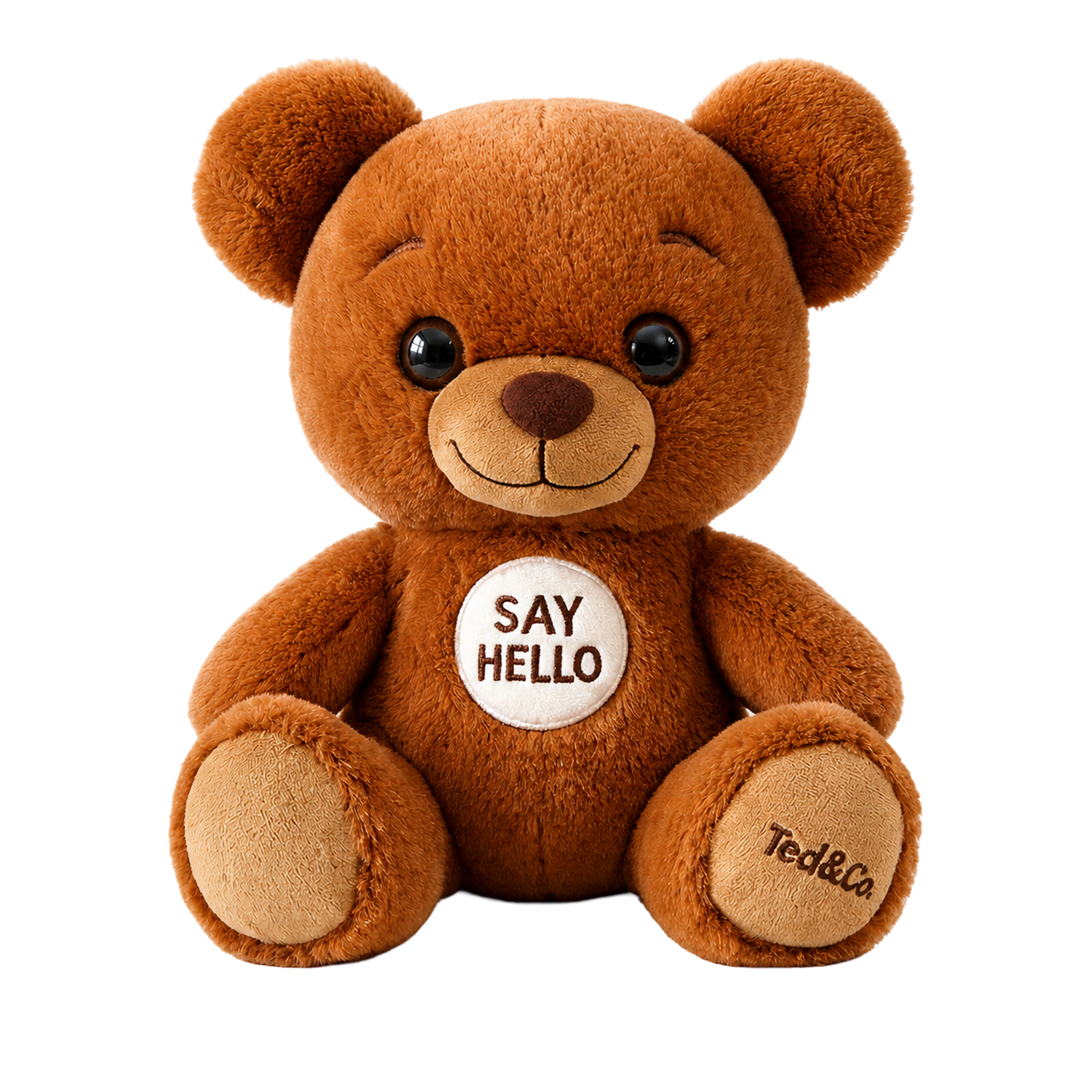
We built Ted before this bill existed, so this is a test we did not write for ourselves. On the hardware points: there is no camera, only a microphone and a speaker, and Wi-Fi is required. On cost: it is a one-off purchase at 129 euros with no subscription and no hidden fees, so nothing about our revenue depends on how long a child keeps talking. On parental control: the setup app is not optional. A parent sets the Wi-Fi, the language, the topics, the limits, the tone, and whether the toy uses push-to-talk or automatic listening. Language switching is manual and stays with the parent in the app; Ted does not change language on its own mid-conversation.
On certifications, the list is CE, RED, EN62115, EN71, RoHS, REACH, ASTM F963, CPSIA, CPC, FCC Part 15, GDPR, COPPA, ISO 9001 and 14001, BSCI, Sedex and SGS. On the marketing point, we hold ourselves to the Maryland wording deliberately: Ted is an interactive plush toy for children aged 3 to 12, it is a tool parents configure, and it is not a substitute for a parent or for anybody else. Our security page sets out how the data side works in detail, and the FAQ answers the questions we get most often. Where a maker will not answer one of the six questions above in writing, that silence is information.
Frequently asked questions
Did Maryland's AI toy law pass?
No. HB 1261 was introduced on 12 February 2026 and referred to the House Economic Matters Committee. A hearing was scheduled and then canceled, and as of 2 September 2026 no further action is recorded. It is a proposal, not law.
Is there a federal law covering AI toys in the United States?
Not one written for AI toys specifically. COPPA governs the collection of personal information from children under 13 online, and the FTC tightened it in 2025. The Consumer Product Safety Commission has stated that psychological and emotional harm falls outside its statutory remit, which is the gap state bills are trying to close.
What does the 48 hour breach notification rule mean in practice?
It would require a manufacturer to tell affected parents within 48 hours of discovering a breach, rather than within the weeks that general data breach laws often allow. For a parent comparing brands today it is a fair question to ask, even where no law requires an answer.
Should I avoid AI toys altogether until the rules settle?
That is a reasonable position and several child advocacy groups take it. If you do buy one, the checklist above is the version of due diligence a regulator would apply. No camera, a stated retention period, real parental controls, no subscription, a published certification list, and marketing that sells a toy rather than a relationship.
Does the bill apply to toys sold outside Maryland?
As drafted it covers AI toys sold in Maryland. In practice, manufacturers rarely build a separate product for one state, so a passed bill of this kind tends to set a floor well beyond its own borders. That is the pattern seen with California's privacy legislation.
Legislative status and figures in this article reflect the public record as of 2 September 2026.