Search for toys that help with speech development and you will find a hundred lists, almost all of them organised by product category: puzzles, farm sets, doctor kits, talking bears. That is the wrong axis. Twenty years of research points to something narrower and far more useful: what matters is not what the toy is, it is how many times the toy makes your child open their mouth, and how many of those moments turn into a real back and forth with a person.
That single idea reorganises the whole shelf. A wooden shape sorter can be a language machine or a silent activity, depending on who is sitting next to it. A talking toy can double a child's speaking time or halve it, depending on whether it hands the turn back. Below is what the evidence actually supports for children roughly aged 3 to 12, including one study that is uncomfortable reading for the entire talking toy category, ours included. If you want the wider picture first, our guide to helping a child build language covers the daily routines that sit underneath any toy choice.
Do toys actually help with speech development?
Toys do not teach speech. People do. What a good toy does is create more reasons to talk, more turns to take, and more shared attention between a child and an adult, and those three things are what the research keeps linking to language growth. A toy is a setting for conversation, not a substitute teacher.
The clearest demonstration of this comes from Rachel Romeo and colleagues at MIT and Harvard, published in Psychological Science in 2018. Working with children aged 4 to 6, they measured both the raw number of words a child heard at home and the number of conversational turns, meaning an adult speaks and the child answers within a few seconds, or the reverse. Turns predicted the child's verbal scores and the activation of Broca's area far better than word count did. You can read the Romeo et al. study in Psychological Science for the full method.
Kathy Hirsh-Pasek and colleagues reached a compatible conclusion in the same journal in 2015, following 60 low income families. Measures of interaction quality, including shared attention and fluent give and take, predicted later language ability better than the sheer quantity of words a mother produced. Their paper is available as The Contribution of Early Communication Quality to Low-Income Children's Language Success.
So the practical question is not "is this an educational toy". It is "does this object produce turns, and does it leave room for a person".
What did researchers find when they compared electronic toys with books and blocks?
They found that electronic toys reduced how much everyone talked. In a 2016 study published in JAMA Pediatrics, Anna Sosa recorded 26 parent and infant pairs playing at home with three toy sets in turn: electronic toys (a toy laptop, a talking farm, a baby phone), traditional toys (a wooden farm puzzle, a shape sorter, ten rubber blocks) and board books. During the electronic toy sessions, parents produced fewer words, responded less often and used fewer content specific words. The infants vocalised less too.
Sosa's interpretation is the part worth remembering: when something else in the room is doing the talking, adults step back and let the toy answer for them. The paper is Association of the Type of Toy Used During Play With the Quantity and Quality of Parent-Infant Communication.
Two honest limits before anyone builds a policy on it. The sample was small, 26 pairs, and the children were 10 to 16 months old, well below the age range most parents are shopping for. And the electronic toys tested in 2016 were one way devices: they played a recorded line whether or not anyone replied. They could not ask anything back.
That study does not validate any product, including ours. What it does is name the failure mode precisely, and the failure mode is a design choice rather than a law of physics. A toy that talks at a child crowds out the adult. A toy that talks with a child, then stops and waits, does something different. The American Academy of Pediatrics reached a similar conclusion in its 2019 clinical report by Aleeya Healey and Alan Mendelsohn: the best toys are not the flashy ones, they are the ones that pull a caregiver into the play. See Selecting Appropriate Toys for Young Children in the Digital Era.
Which toys help with speech development between ages 3 and 12?
The toys that consistently produce language are open ended, slightly under specified, and impossible to finish alone. Anything that forces a child to describe, negotiate, explain or invent will generate more speech than a toy that performs. Age matters less than the amount of blank space the toy leaves.
| Age | What the child is working on | Toys that generate the most talk |
|---|---|---|
| 3 to 4 | Being understood by people outside the family, telling a simple story from a book | Board books, wooden animals, play kitchens, dressing up boxes, blocks |
| 4 to 5 | Longer sentences, connecting ideas with words like "and" and "because", naming characters and settings | Small world figures, story cubes, simple board games with turn taking, puppets |
| 6 to 8 | Explaining rules, arguing a point, holding a longer narrative together | Cooperative board games, construction sets with no instructions, riddle and guessing games |
| 9 to 12 | Precision, vocabulary depth, defending an opinion | Strategy games, word games, model building, anything requiring instructions read aloud to someone else |
The age bands come from the developmental sequence described by the American Speech-Language-Hearing Association in its communication milestones. ASHA is explicit that children vary widely within the same family, so treat these as a direction of travel rather than a schedule. If you want the numbers behind them, we covered vocabulary milestones age by age separately.
How can you tell whether a toy will build language or end the conversation?
Watch one thing: what happens in the two seconds after the toy makes a sound. If the child's next move is to speak, the toy is working for language. If the child's next move is to wait, press or watch, the toy has taken the turn and kept it.
Five checks you can run in a shop, or in the first ten minutes at home:
- Does it ever ask a question? A toy with a fixed script cannot. A toy that responds to what was actually said can, and should.
- Can it be wrong? Toys that always produce the right answer teach children to consume. Toys that can be corrected teach children to argue, which is speech.
- Does it stop? If there is no silence, there is no room for a child or an adult to say anything.
- Can two people use it at once? The AAP's central point. A toy a parent can join is worth more than a toy a child uses alone.
- Does it survive without batteries? Not a moral test, a practical one. If the toy is only interesting when powered, it is entertainment, and entertainment is fine, it is just not language work.
Do talking toys count as speech practice?
Only when the child does most of the talking. A talking toy that reads a story aloud is closer to an audiobook than to a conversation, which is not a criticism, audiobooks are good for vocabulary. A toy that asks a child what happened next, waits, and then builds on the answer is doing something structurally different, because it produces the conversational turns Romeo's team measured.
There is no published trial showing that any consumer talking toy improves measured speech outcomes in children. Anyone claiming otherwise is ahead of the evidence. What can be said with confidence is narrower and still useful: turns are what correlate with language growth, and a toy either produces them or it does not. That is a testable property you can observe on your own living room floor in one afternoon.
The other thing worth checking is whether the toy asks the child to speak in a language they are actually building. A child who is practising a second language needs to produce sentences in it, not only hear it. We looked at how much of that is typical variation and what counts as a red flag in a separate piece, because "quiet" and "delayed" are not the same thing.
What should you do if you are worried about your child's speech?
Stop shopping and get an assessment. No toy substitutes for a speech and language evaluation, and the single strongest predictor of a good outcome is starting early. Ask your paediatrician or family doctor for a referral, and do not wait to see whether it resolves on its own.
ASHA's public guidance on how speech and language develop is a reasonable first read, and includes the signs that warrant a professional opinion. Toys belong to the enrichment side of the picture. They are not a treatment, and any product marketed as one should be treated with suspicion.
How do you fit these toys into an ordinary week?
Fifteen minutes of real back and forth beats an hour of parallel play, and it does not need a new toy. Pick one moment that already exists, the walk home, the bath, the ten minutes before lights out, and make it the moment where you ask questions you do not know the answer to. Then let the silence sit long enough for your child to fill it.
Rotate rather than accumulate. Keep a small number of open ended things visible and put the rest away for a month. Novelty restores interest without adding to the pile, and a smaller shelf makes the choosing itself a conversation.
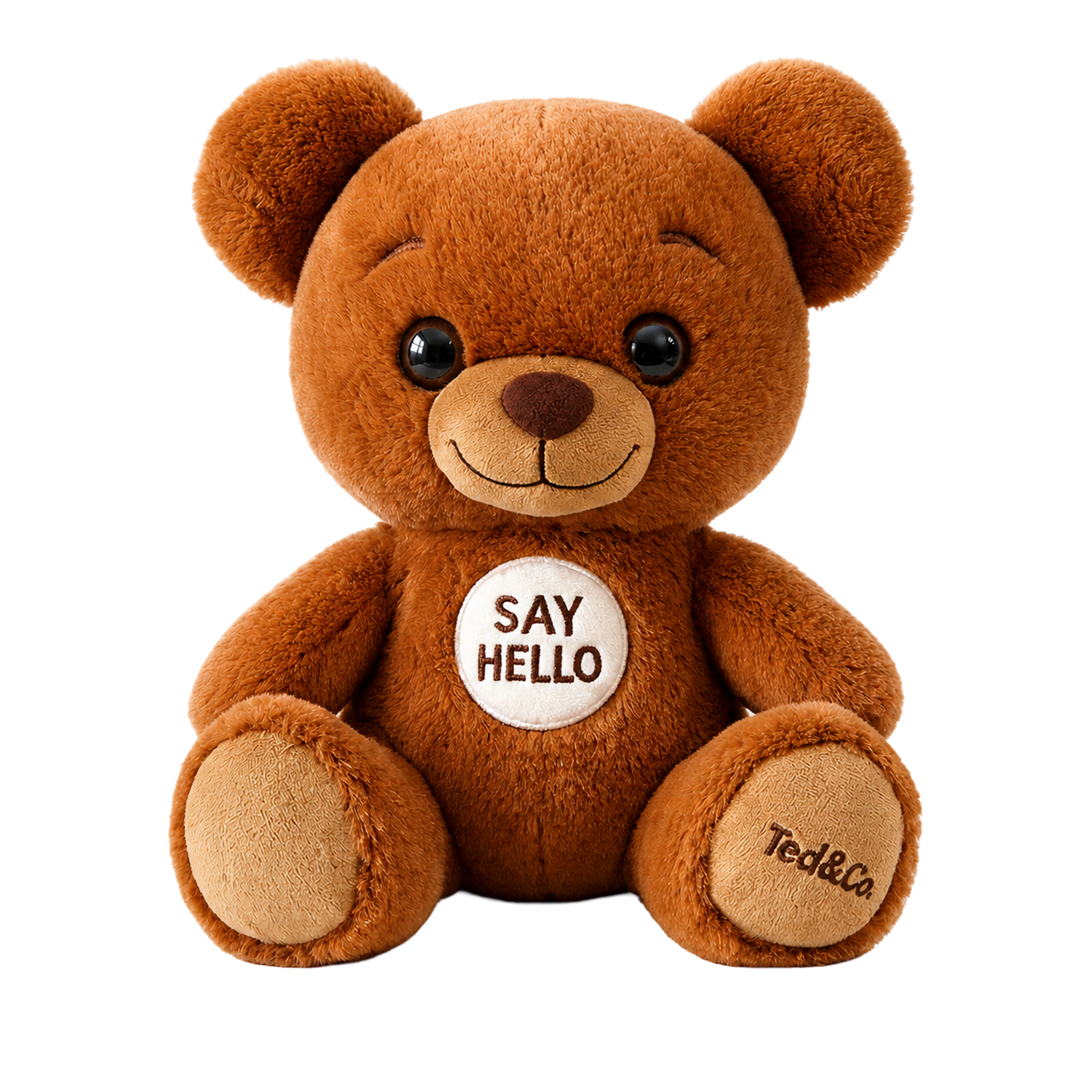
And if you are considering something that talks, apply the five checks above before the marketing. That is the standard we built Ted, our interactive plush toy against: it holds a real time conversation rather than playing recorded lines, it asks the child questions back and then waits, it has no camera, and the language, the topics and the limits are set by a parent in the app rather than by the toy. It is a tool for the conversation, not a replacement for the person having it.
Frequently asked questions
Do electronic toys cause speech delay?
No study has shown that electronic toys cause speech delay. Sosa's 2016 work in JAMA Pediatrics showed that during play with electronic toys, parents and infants talked less than they did with books or traditional toys. That is a measure of the play session, not a diagnosis, and the study followed 26 pairs of infants aged 10 to 16 months.
What is the single best toy for speech development?
Books, on the current evidence, because they consistently produce the most adult speech and the most turns. In Sosa's comparison, board books outperformed both traditional and electronic toys on nearly every communication measure.
My child talks constantly but is hard to understand. Is that a toy problem?
No. Volume of speech and clarity of speech are different skills. ASHA notes that by age 4, most people should understand most of what a child says. If strangers regularly cannot, that is a reason to ask for a speech and language assessment rather than to change toys.
Should I correct my child's mistakes while we play?
Repeat the sentence back correctly rather than asking the child to say it again. If your child says "he goed there", answering "yes, he went there, and then what happened" keeps the exchange alive while modelling the right form. Direct correction tends to shorten the conversation, which is the opposite of what you want.
Does screen based language learning count?
It can add vocabulary, but it rarely produces conversational turns, because a screen does not wait for an answer or adapt to a wrong one. The research consistently favours whatever format gets a child speaking out loud to a responsive listener. Treat apps as a supplement to that, not a replacement for it.