Your child asks for a story. Not a book: a story, one that comes out of your head, right now, with a dragon in it, and a scooter, and them. If you have ever gone completely blank at that exact moment, this is the practical version of how to make up a bedtime story, including the part where you have no ideas at all.
Inventing a story is not a performance, and nobody is grading the plot. Most of what makes it worth doing sits in the back and forth between you and your child, not in how clever the ending is. Below you will find a five-line structure you can reuse every night, guidance on length, what to do when your child hijacks the story, and an honest look at what the evidence does and does not show. If your evenings feel scattered before you even reach the story, start further upstream: building a bedtime routine is what makes the story slot possible in the first place.
How do you make up a bedtime story when you have no ideas?
Ask your child for three ingredients and build the story out of those. A character, a place and a problem is enough, and because your child chose them, you are no longer inventing from nothing. The whole exchange takes about fifteen seconds and it removes the blank page entirely.
The questions can be very plain. Who is in the story tonight? Where are they? What goes wrong? A four year old will hand you a hedgehog, a swimming pool and a lost shoe, and that is a complete premise. A nine year old will give you something more elaborate and will usually keep editing it as you go, which is fine and in fact useful.
Two things make this easier over time. First, keep a short mental list of premises that worked, because children happily accept the same skeleton with new characters. Second, resist the urge to prepare. A story you rehearsed in the shower tends to come out as a monologue, and a monologue is the one shape that does not invite your child to join in.
What is the simplest structure for a made-up bedtime story?
Five sentences will hold an entire story: a beginning, a normal day, a break in the routine, one attempt to fix it, and a soft landing. You say those five lines and let your child fill in the detail between them. This is the structure improvisers use, and it works because it gives you the next move at every point.
A worked example, in full: once upon a time there was a hedgehog called Bruno who lived behind the swimming pool. Every day he counted the tiles through the fence, always stopping at forty one. But one day someone left the gate open. Because of that Bruno got in, floated all the way to the deep end, and could not work out how to climb back out. Until finally the night guard found him, carried him home in a towel, and left the gate open a little on purpose every Tuesday after that.
That is roughly ninety seconds of talking. Stretch it by asking questions instead of adding sentences: what did the water feel like, what was Bruno thinking, what would you have done. The story gets longer without you having to invent more of it.
How long should an invented bedtime story be?
Five to ten minutes is plenty for most children between three and twelve, and the end of the story should sit inside the wind-down, not at the end of it. What matters more than the duration is that it happens in the same place in the evening most nights.
That last point is the one with the strongest evidence behind it. In a study of more than ten thousand mothers published in the journal Sleep, Jodi Mindell and colleagues found a dose dependent relationship between how many nights a week a family ran a bedtime routine and how the child slept: earlier bedtimes, faster sleep onset, fewer night wakings, longer nights. The relationship held across countries and income levels. It is correlational, so it does not prove the routine causes the sleep, but the gradient is hard to ignore.
For how much sleep the story is protecting, the reference point is the American Academy of Sleep Medicine's consensus advisory on child sleep duration, which sets nine to twelve hours for children aged six to twelve and ten to thirteen hours for three to five year olds. Those figures were endorsed by the American Academy of Pediatrics. If the story is regularly pushing bedtime past those windows, shorten the story rather than the sleep.
Should your child be a character in the story?
Yes, and it is usually the single change that makes a made-up story land. Putting your child in it turns a passive listen into something they have a stake in, and it gives you an easy engine for the plot: their real day, slightly bent.
There is a useful piece of research nearby. In a training study published in Child Development, Elaine Reese and Rhiannon Newcombe showed that mothers coached to reminisce elaborately, asking open questions and building on what the child offered rather than quizzing them, had children who produced richer and more accurate memory narratives a year later. That study is about talking through real events, not invented ones, so treat it as an argument for the conversational style rather than proof that fiction does the same thing. The transferable part is the move: ask, wait, build on the answer.
In practice, that means the version of your child inside the story should get to decide things. If the hedgehog is stuck, ask what your child would do, then have the character do it. Children who are used to being asked will start volunteering plot; children who are not will take a few nights. Both are normal, and it is closely related to why a child will ask for the same story night after night: familiarity is what frees up the attention to play with the material.
What do you do when your child interrupts and takes over?
Let them. An interruption is your child joining the story, which is the outcome you were aiming at, and the plot is not worth defending. Say yes to whatever they add and keep going from there.
The one rule worth holding is continuity. If your child declares that the hedgehog can fly, the hedgehog can fly, but the swimming pool is still a swimming pool and Bruno is still Bruno. Keeping the world stable while accepting the additions is what teaches the shape of a story rather than a pile of events.
If your child wants to tell the whole thing themselves, hand it over completely. The largest classroom evidence on this comes from a cluster randomised trial of a storytelling and story acting practice in low income preschools, reviewed by the What Works Clearinghouse, in which children dictated their own stories and then acted them out with classmates. The honest caveat is that it was a classroom programme with teachers and an audience of peers, not a parent at a bedside, and the reviewed effects were modest and uneven across outcomes. It is a reason to make room for your child's own stories, not a promise about what will happen. If you want the version built for home, we covered it in getting a child to tell their own stories.
Is telling a story better than reading a book aloud?
Neither one wins outright, and the useful framing is that they do different jobs. A book gives your child language they would not have met otherwise and pictures to anchor it; an invented story gives them a say in what happens next. Most families end up alternating without thinking about it.
There is one piece of brain imaging that speaks to the difference. John Hutton and colleagues scanned twenty seven preschoolers while they experienced the same stories in audio only, illustrated and animated formats. In the audio condition, language networks worked hard but connectivity with the imagery network was comparatively low; the animated condition showed high visual activity with weaker language network connectivity and the poorest comprehension; the illustrated version sat in between and looked the most balanced. The sample was small and the children were preschoolers, so this is a signal rather than a verdict. What it does suggest is that a story with nothing to look at asks a lot of a young child's imagination, which is an argument for keeping invented stories short and concrete rather than for abandoning them.
| What you are doing | What it is good at | When to reach for it |
|---|---|---|
| Reading a picture book aloud | New vocabulary, sentence structures a parent would not improvise, images to lean on | Younger children, tired parents, a child who is not in a talkative mood |
| Telling an invented story | Your child shapes the plot, the story can absorb whatever happened that day | Anxious evenings, long car journeys, a child who wants to negotiate |
| Your child telling you a story | Practice producing an extended, connected stretch of language | Once the habit exists, roughly one night in three |
How do you make an invented story part of the evening for good?
Attach it to something that already happens rather than adding a new step. Teeth, then lights low, then the story, in that order, most nights. A routine that has to be remembered is a routine that will lapse within a fortnight.
Expect a few things to go wrong. Some nights you will produce ninety seconds of nonsense and your child will accept it happily. Some nights they will insist on a story you told in March and you will not remember a word of it, which is a good moment to ask them to tell it to you instead. And some nights nobody has the energy, which is what books are for.
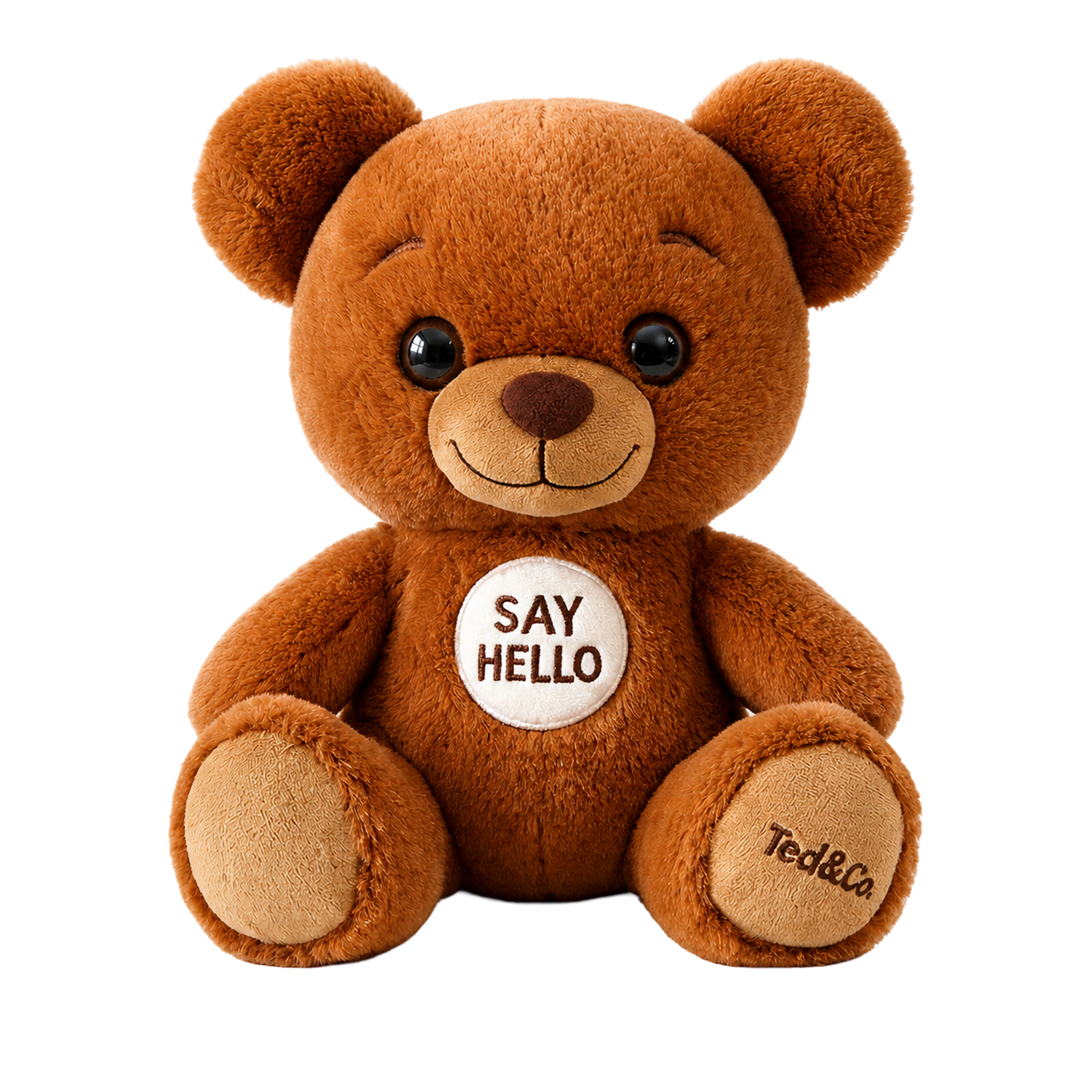
If invented stories become a fixture in your house and you want your child to keep telling them when you are not the audience, that is one of the things Ted, our interactive plush toy, was designed around: it holds a conversation in real time rather than replaying recorded lines, so a child can build a story out loud and be asked questions back. Parents set the language, the topics and the limits from the app, there is no camera, and it is a one off purchase at 129 euros with no subscription. It is not a replacement for the five minutes you spend at the bedside, and it should not be: the point of the bedtime story has always been that someone is listening.
Frequently asked questions
I am not creative. Can I still make up a bedtime story?
Yes, because you are not being asked to invent much. If you take three ingredients from your child and use the five line structure, the only thing you personally supply is the break in the routine. Everything else is either your child's idea or scaffolding.
At what age can a child follow a story with no pictures?
Most children manage a short, concrete invented story from around three, provided it involves people and places they know. Abstract or long stories with many characters tend to land better from six or seven. If your child drifts, shorten the story and add more dialogue.
Is it bad if the story is always the same?
No. Repetition is doing real work on vocabulary and on the sense of safety that helps a child settle, and children usually start varying it themselves once they know it well. Change one element at a time rather than starting from scratch.
Should the story be calm or can it be exciting?
Exciting is fine in the middle and a problem at the end. Build the tension early, then spend the last minute winding down, with the characters going somewhere quiet. The last thirty seconds set the mood your child takes into the dark.
What if my child asks for a story about something difficult, like a fight at school?
Follow their lead, keep the characters fictional, and let the story end better than the real day did. Children often use invented stories to rehearse things they cannot say directly. If the same theme keeps coming back over weeks, that is worth raising with their teacher or your paediatrician rather than solving inside the story.