Multilingual toys for kids are everywhere now: board books that read aloud in two languages, tablets that drill vocabulary, audio players loaded with stories, plush toys that speak several languages. The promise is simple and appealing, that a child can pick up a second language through play. The published research is more specific than the marketing, and the difference matters if you are about to spend money.
What follows is what the evidence supports, and what it does not. The short version is that the language coming out of the toy matters far less than what happens around it. Studies that tracked real children found that back and forth exchange, not recorded output, is what moves a child forward. That one finding changes both which toy is worth buying and how you use it.
Do multilingual toys for kids actually teach a second language?
On their own, no. No toy on the market has been shown in published research to teach a child a second language without a person involved. What the better designed ones do is create regular, low friction contact with a second language, which is a genuine contribution when it sits alongside conversation, books and songs.
This is not a small distinction. A toy that a child presses and walks away from is background noise. A toy that pulls a child into naming, repeating, answering or arguing is doing something closer to what a tutor does. When you compare products, the useful question is not how many languages are listed on the box, but how often the toy makes your child open their mouth. If you want the wider picture on helping a child build language, that is the place to start.
What does the research say about exposure versus interaction?
Interaction wins, and the gap is large. The clearest demonstration is still a 2003 study in which nine month old American infants were exposed to Mandarin over twelve laboratory sessions. Infants who heard live Mandarin speakers kept their ability to distinguish Mandarin sounds. Infants who received the identical material as audio only or video only showed no such learning.
That study, by Patricia Kuhl, Feng-Ming Tsao and Huei-Mei Liu, was published in the Proceedings of the National Academy of Sciences. It is the reason researchers talk about a video deficit: the same words, delivered without a responsive partner, simply do not land the same way in the first years of life.
A larger study makes the positive case. In 2017, researchers at the University of Washington Institute for Learning and Brain Sciences ran an intensive, play based English programme in four public infant education centres in Madrid, enrolling 280 children aged 7 to 33.5 months. Children got one hour a day for 18 weeks. The results, reported by UW News and published in Mind, Brain, and Education, were striking.
Two details matter. The children kept their gains when retested 18 weeks later, and their Spanish continued to develop normally, which answers the most common parental worry about introducing a second language early.
What kinds of multilingual toys exist, and what does each one do?
Broadly there are five categories, and they are not interchangeable. Some deliver vocabulary, some deliver structure, and only a few invite a response. The table below sorts them by what they ask of the child, which is the variable the research keeps pointing to.
| Type of toy | What it delivers | Does it ask for a response? |
|---|---|---|
| Bilingual board books | Vocabulary in context, plus a reason for an adult to sit down | Yes, through the adult reading them |
| Talking books and sound buttons | Isolated words, correct pronunciation | No, one press gives one output |
| Audio story players | Long form listening, sentence rhythm, narrative structure | No, but it builds listening stamina |
| Vocabulary apps and tablets | Drilled word lists, repetition, scoring | Taps only, rarely speech |
| Talking plush toys | Spoken exchange, questions back to the child | Yes, if the toy handles real conversation |
Note what the table does not say. None of these categories is useless, and the cheapest option on it, a bilingual board book, performs extremely well precisely because it puts an adult in the room.
How much practice does a child actually need?
The honest answer is that nobody has a universal number, but the Madrid programme gives a usable reference point: one hour a day, five days a week, for 18 weeks produced measurable, durable gains. That is far more than most families manage at home, and far less than immersion.
What matters more than the total is the regularity and the quality of the turns. A 2018 study in Psychological Science by Rachel Romeo and colleagues recorded the home language environments of 36 children aged 4 to 6. Children who experienced more conversational turns showed greater activation in Broca's area, the brain region tied to language production, and the link with verbal skill held independently of family income, IQ and the sheer number of words heard. Counting words was the weaker predictor. Counting exchanges was the stronger one.
Practically, ten focused minutes a day in which a child is answering beats an hour of passive playback. We set out a week by week version of this in our guide to teaching a child a second language at home.
What do multilingual toys not do?
They do not replace the adult, and some of them quietly crowd the adult out. This is the most important finding for any parent buying an electronic language toy, and it comes from research that is not flattering to the category.
In a controlled study published in JAMA Pediatrics, Anna Sosa of Northern Arizona University recorded 26 parent and infant pairs at home playing with three sets of materials: electronic toys that light up and talk, traditional toys such as wooden puzzles and blocks, and board books. During play with electronic toys, parents used fewer words, took fewer conversational turns, responded less often, and used fewer content specific words. Children also vocalised less than they did with books. The largest and most consistent gaps were between electronic toys and books.
The honest limit
Sosa's study had 26 families, all broadly similar in background, and the children were 10 to 16 months old, younger than the age most language toys target. It does not prove that every electronic toy suppresses conversation. In an accompanying editorial, paediatricians Jenny Radesky and Dimitri Christakis framed the risk precisely: the danger is a child getting stuck in a toy's closed loop rather than carrying what they learned back into the room. That is a design problem, not an inevitability, and it is the single thing worth testing before you commit to a product.
How do you choose a multilingual toy that gets used?
Test one thing before anything else: does the toy ask your child a question it does not already know the answer to? Everything else follows from that. A toy that only emits will be abandoned within weeks, whatever it cost.
Beyond that, four checks are worth making. Is the pronunciation natural speech from a native speaker rather than a synthesised word list? Does the second language appear in whole sentences, since children learn structure from strings and not from isolated nouns? Can you control when the second language appears, so a tired child is not pushed into it at bedtime? And does the toy suit your child's current stage, which you can check against the developmental milestones and speech development guides published by the American Speech-Language-Hearing Association?
The NCT's practical guidance for families raising a bilingual child makes a related point that toy marketing tends to skip: consistency about which language is used when, and by whom, does more than variety. Our review of toys that help with speech development applies the same test to first language work.
Where does a talking plush fit into a family's language routine?
It fits as the practice partner, not the teacher. A talking plush earns its place if it gives a child somewhere to try out a language without an audience and without being corrected, and if the parent stays in the loop about what is being practised. It fails if it becomes the only place the second language ever appears.
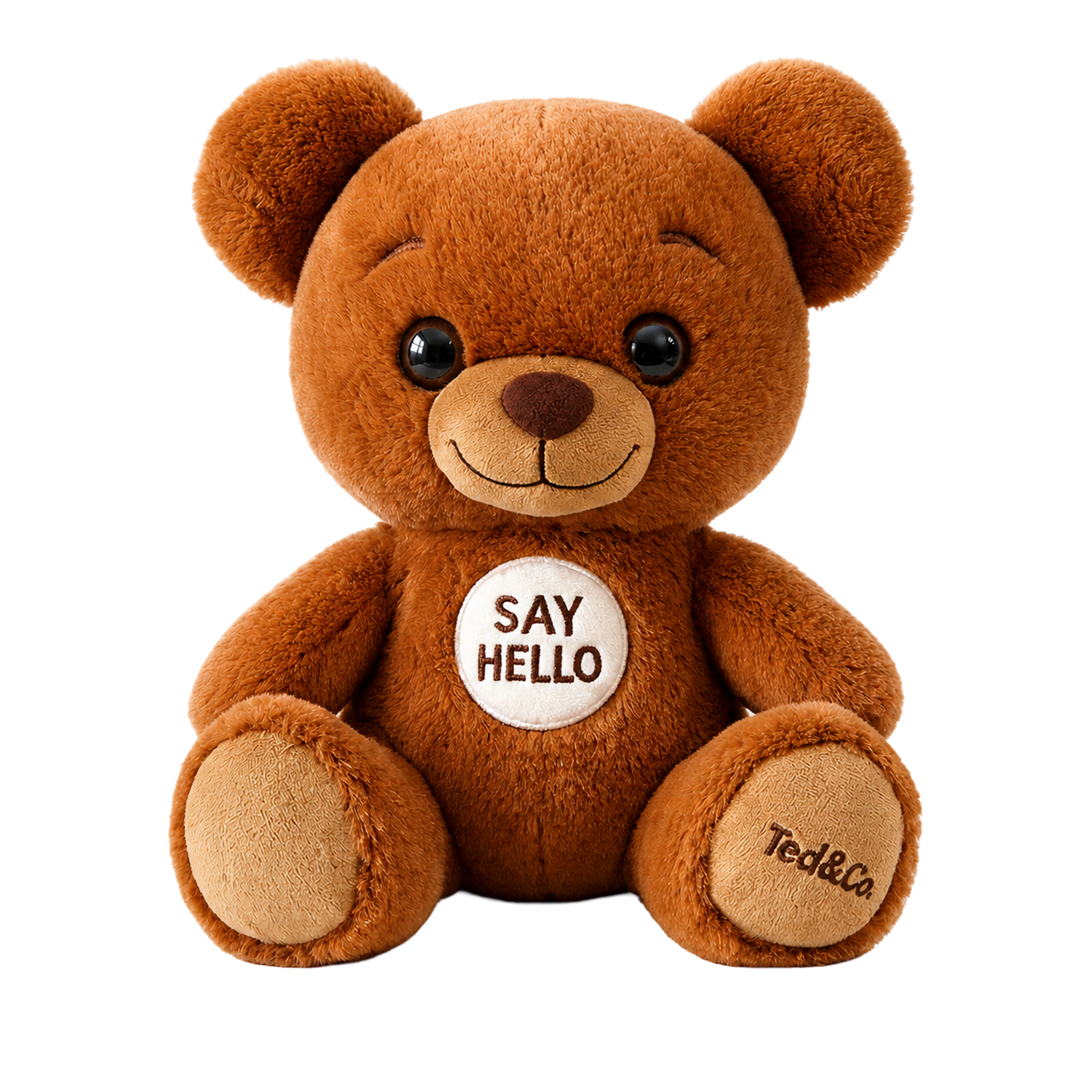
This is how we built Ted, our interactive plush toy for children aged 3 to 12. Ted holds a real conversation rather than replaying recorded phrases, and it asks questions back. One design choice is deliberate: the language is set by the parent in the app, manually. Ted does not switch languages on its own mid conversation. A child working on a second language stays in that language for the session, which is the consistency the NCT guidance describes, and the parent decides when to change it. There is no camera, no subscription, and the app is where you set topics, tone and limits.
Whatever you choose, the research points the same way. Buy the thing that makes your child talk back, then stay in the room.
Frequently asked questions
At what age should I introduce a multilingual toy?
There is no threshold age, and the Madrid programme worked with children as young as seven months. What changes with age is the format: under three, shared books and songs with an adult do more; from three onwards, toys that invite a spoken answer become genuinely useful because the child can hold a turn.
Will a second language confuse my child or delay their speech?
The evidence does not support that worry. In the Madrid study, the children's native Spanish kept developing normally while they learned English. If you have specific concerns about your child's speech, compare what you are seeing against the ASHA milestones and speak to a speech and language therapist rather than adjusting the languages at home.
Are expensive multilingual toys better than cheap ones?
Price predicts very little. Sosa's study found that inexpensive board books produced the richest language exchanges of anything tested, and the authors explicitly cautioned against buying expensive electronic toys marketed as educational. What you are paying for in a higher priced toy is conversation quality, not vocabulary volume.
My child ignores the second language and answers in ours. Is the toy failing?
Not necessarily. Understanding almost always runs ahead of production in a second language, sometimes by months. A child who responds correctly in their stronger language has understood. Keep the exposure consistent and avoid making production a condition of the activity.
How long before I see any progress?
Expect months, not weeks. The Madrid children had 18 weeks of daily sessions before the measured gains reported above. At the ten minutes a day most families manage, progress shows up first as comprehension: your child reacts to an instruction before they ever repeat it.