Most toys marketed as "bilingual" or "educational" for toddlers are electronic boxes with buttons: press one, hear a word in two languages, press another. Parents buy them assuming more language input helps. The research on what actually happens during play with these toys says something more specific, and it changes what to look for.
A landmark study found that electronic toys measurably reduce how much parents and toddlers talk to each other during play, compared with books or simple traditional toys. That does not mean every toy with a language feature is a bad choice. It means the mechanism matters more than the label. This sits inside our broader guide to helping a child build language, and here we focus specifically on toddlers, roughly ages 1 to 3.
What does "bilingual toy" actually mean for a toddler?
In practice, it means one of two very different things: a toy that plays back pre-recorded words or phrases in more than one language, or a toy that responds to what the child says or does and builds a back-and-forth exchange. The first is common and cheap to make. The second is rare below age 3, because reliable two-way conversation with a toddler's still-developing speech is a hard engineering problem.
The distinction matters because a toy that plays a fixed phrase does not need a reply, and a child does not need to produce one. A toy built around exchange invites the child to respond, which is closer to how language is actually learned: through use, not exposure alone.
Do electronic toys help or hurt language development?
Neither, automatically. The evidence points to a specific problem: many electronic toys reduce the amount of talking parents and children do together while playing, not because the toy is malicious, but because a toy that fills the silence gives a parent less reason to fill it themselves.
Anna Sosa's study for JAMA Pediatrics had 26 parent-infant pairs play with board books, traditional toys (blocks, puzzles, shape sorters), and battery-operated electronic toys, three days each. Parents used the fewest words per minute, the fewest unique words, and had the fewest back-and-forth exchanges during electronic-toy play. The toys were not conversational. They played a fixed set of sounds regardless of what the child did, which is the key difference from a toy built to respond.
What does the research say about parent-child talk during play?
The strongest predictor of later vocabulary is not how many words a child hears, but how many conversational turns happen, meaning back-and-forth exchanges where each side responds to the other. The Center on the Developing Child at Harvard calls this "serve and return": a child reaches out with a sound or gesture, an adult (or in principle, a responsive toy) answers in a way connected to what the child did, and the exchange continues.
This is why a toy's language claim is the wrong first question. The better question is whether the toy is built to notice what a toddler does and reply to it, or whether it plays the same clip regardless. A toy that says a phrase in two languages on a timer is not doing serve and return. A toy built to answer what is actually said is doing something closer to it, though for toddlers under 3 that kind of exchange is still limited by how much the child can reliably say, per ASHA's guidance on typical speech and language development.
What should a bilingual toy for a toddler actually do?
Three things separate a toy worth the shelf space from one that is not, based on what the research above actually measured.
- It should prompt a reply, not just play one. A question, a pause, or a request for the child to point or repeat does more for language than a monologue, however well pronounced.
- It should not replace the parent's voice during play. Toys that work best alongside a parent talking, rather than instead of them, are the ones the research supports. A toy in a shared room, used with a parent nearby, keeps the exchange going in both directions.
- It should be honest about what it does at each age. A toy is not doing more for a 14-month-old just because its box says "bilingual." At that age, the toy's job is to not crowd out talk, not to teach vocabulary on its own.
Which toys work best at each stage from 1 to 3?
Under about 18 months, plain books and simple cause-and-effect toys, the kind NCT's guidance on raising a bilingual child recommends pairing with everyday narration, do more than any electronic toy, bilingual-labelled or not. Between 18 months and 3 years, children start initiating short exchanges and can hold a very simple back-and-forth, which is when a toy designed to respond, rather than recite, starts to add something a passive toy cannot.
| Toy type | What it does | Best fit |
|---|---|---|
| Books and simple toys | No language output; depends entirely on the adult narrating | Under 18 months, every age as a supplement |
| Button-based electronic toy | Plays fixed phrases on a timer or button press | Rarely adds language value; can reduce parent talk |
| Conversational toy (age 3+) | Responds to what the child actually says, in real time | From around age 3, alongside parent talk, not instead of it |
Ages are general guidance, not fixed thresholds. Every child's pace differs.
How do you tell a responsive toy from a scripted one in the shop?
Packaging rarely tells you. A few minutes of testing does. Say something unexpected to the toy, then a nonsense word, then nothing at all, and watch what happens in each case.
- Say something off-script. A scripted toy either ignores it or plays the same phrase it would have played anyway. A responsive toy changes its reply based on what it actually heard.
- Wait in silence. A toy built around a timer will eventually speak on its own, filling the pause a parent might otherwise fill. A toy built around exchange stays quiet until it is prompted again, which matters because the pause itself is where a toddler often produces their own first attempt at a word.
- Ask the same question twice. Identical wording every time is the clearest sign of a fixed script. Natural variation in phrasing is a sign the reply is generated rather than played back.
None of this makes a scripted toy worthless. A simple, well-made toy that plays a nursery rhyme or names an animal in two languages can still be a fine toy. The point is not to expect it to do the work of a conversation, and not to let it replace the minutes a parent would otherwise spend narrating play out loud.
Is a conversational AI toy right for a toddler?
For the youngest toddlers, the honest answer is not yet. A conversational toy needs a child who can produce enough speech for the exchange to work, which the research above places closer to age 3 than age 1. Below that, a parent's own voice, a board book, or how to teach a child a second language at home through daily routine does more than any device. The same responsiveness that makes an exchange work for a second language is also what separates toys that genuinely help with speech, as we cover in our guide to toys that help with speech development.
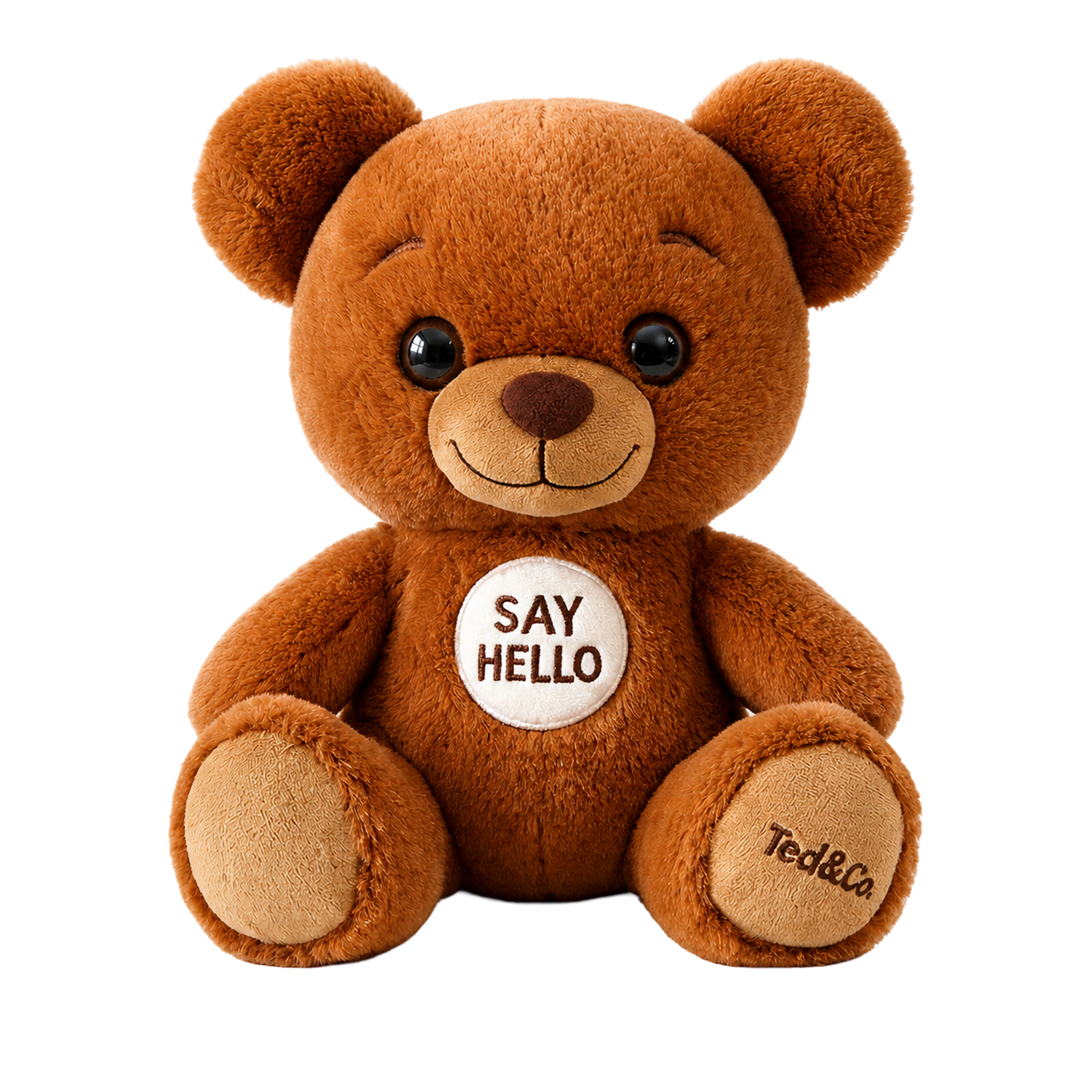
Ted, made by Ted&Co, is built for ages 3 to 12 for exactly this reason: real conversation, not playback, only becomes useful once a child can sustain one. Ted has no camera, needs no subscription, and its language is changed manually by a parent from the app, never on its own mid-conversation. For a family working on a second language at home, that means the parent decides what language a toddler-turned-preschooler hears from the toy, and when. You can see the full setup on the Ted&Co product page.
Frequently asked questions
Do bilingual electronic toys actually teach a second language?
Not on their own. The research on toy type and language shows electronic toys, bilingual-labelled or not, tend to reduce parent-child talk rather than add to it. A toy is a supplement to a parent talking, not a substitute.
What age should a toddler start using a language toy?
Books and narration work from birth. Toys that respond to what a toddler actually says become meaningfully useful closer to age 3, when a child can sustain a short back-and-forth exchange.
Is screen time the real issue with electronic toys?
No. The Sosa study used no screens at all; the toys were battery-operated and non-visual. The reduction in talk came from the toy filling the silence, not from a screen.
Can a talking toy replace reading aloud?
No, and none of the research supports that framing. Reading aloud and narrated play produced the highest rates of parent talk in every comparison studied; a responsive toy sits alongside that habit, not in place of it.
How many languages does a toddler need to hear to become bilingual?
There is no fixed threshold, but University of Washington research on infant language exposure found that regular, real interaction in a second language, even in short weekly sessions, measurably shifted infants' brain responses to that language.