Personalized bedtime stories, the ones where your child is the hero, get sold to parents as a small piece of magic. They are less magic than that, and more interesting. There is real evidence about what putting a child inside a story does to their attention and their memory, and separate evidence about what the talking part of a bedtime routine does to their sleep, sometimes years later.
What follows is what the research actually supports, what it does not, and how to make one in about ninety seconds without buying anything. If you are still assembling the evening itself, our guide to building a bedtime routine covers the sequence around the story.
Do personalized bedtime stories actually help children sleep?
There is no study showing that personalizing a story, on its own, makes a child fall asleep faster. What is well established is that having a consistent bedtime routine does, and that a story is one of the most common things inside that routine. Personalization is best understood as something that makes the story easier to sustain night after night, not as an active sleep ingredient.
The size of the routine effect is worth knowing. In a multinational study of 10,085 mothers across 14 countries led by Jodi Mindell, children with a nightly bedtime routine slept, on average, more than an hour longer per night than children who never had one. The relationship was dose-dependent: more nights with a routine meant better sleep, and starting younger helped. As Mindell put it in the American Academy of Sleep Medicine's summary of the study, doing it one day a week is good, three days is better, every day is best.
So the question is not whether a personalized story beats a book. It is whether it makes you more likely to do the routine tonight, tomorrow and on the fourth night when everyone is tired. That is the variable the evidence cares about.
What did the twelve-year follow-up study find?
It found that the talking part and the touching part of a bedtime routine appear to do different jobs, and that the effects were still measurable more than a decade later. This is the most interesting recent result in this area and it has not been widely reported.
Researchers led by Olivia Martín-Piñón, working with data from the Future of Families and Child Wellbeing Study, followed 484 young people. When the children were three, their mothers recorded which bedtime activities happened: communication activities such as reading and singing, and physical contact activities such as cuddling, rubbing the child's back, or a comfort object. Sleep was then measured objectively with actigraphy, a wrist device, at ages 15 and 22.
Children whose bedtimes at age three had included communication activities showed less night-to-night variability in their sleep at fifteen: 9.56 minutes less variability in time in bed and 8.76 minutes less in actual sleep minutes. Children whose bedtimes had included physical contact showed better sleep quality instead, with higher sleep efficiency and less time awake after falling asleep.
| Activity at age 3 | What it predicted at age 15 |
|---|---|
| Communication: reading, telling stories, singing | A steadier sleep schedule, less variation from night to night |
| Physical contact: cuddling, back rubs, a comfort object | Better sleep quality, higher efficiency, less time awake in the night |
| Either, measured again at age 22 | No detectable association |
The honest caveats matter here. This is a conference abstract presented at SLEEP in May 2026, not yet a full peer-reviewed paper. It is observational, so it shows association and not cause. The effects are modest, around nine minutes, and by age 22 they had disappeared entirely, which the authors attribute to work, study and independence taking over. What survives is a reasonable conclusion: the talking and the touching are not interchangeable, and both are worth having.
Why does a child remember a story better when they are in it?
Because of a well-documented memory bias called the self-reference effect. Information connected to the self is encoded and recalled better than the same information connected to someone else, and this shows up in children well before school age. It is the mechanism behind why your child can recite the plot of the story where they rescued the dog, and not the one you read from a book on the same evening.
The developmental work here is solid. Sheila Cunningham and colleagues, publishing in Child Development, found a self-reference advantage for both item recognition and source memory in four to six year olds. Later work extended it to word learning: when preschoolers were told that objects belonged to them rather than to another character, they retained the new words attached to those objects noticeably better.
Here is the limit, and it is one that most articles on this topic leave out. In that word-retention study, the self-reference advantage was strong immediately but was no longer statistically significant four hours later, or the following morning. The boost to attention and encoding is real. The claim that a personalized story permanently plants vocabulary in your child is not supported.
What actually goes into a personalized bedtime story?
Four elements, and none of them require writing talent. A personalized story means your child's name and a recognisable version of their day, not an elaborate plot.
- The child, by name, as the one who acts. Not the one things happen to. This is the part the self-reference effect depends on.
- One real detail from their day. The lost glove, the new girl at school, the dog on the corner. It is what makes the story theirs rather than generic.
- A small problem the child solves. Small is the operative word at bedtime. Nothing frightening, nothing unresolved.
- A quiet, predictable ending. The same closing line every night, if it works. Predictability is the point of a routine.
If inventing on the spot is not your strength, we have a step-by-step version in how to make up a bedtime story for your child. And if your child asks for the same story every single night, that is not a failure of your storytelling, it is a well-documented preference we cover in why children want the same bedtime story every night.
What a personalized story does not do
It does not treat a sleep disorder, resolve anxiety, or make a child bilingual. Those claims circulate widely in marketing for bedtime products, including some aimed at parents of children who genuinely are not sleeping, and there is no evidence base for them.
If your child regularly takes more than thirty minutes to fall asleep, wakes repeatedly, snores, or is exhausted during the day, that is a conversation for your paediatrician rather than a storytelling problem. The American Academy of Sleep Medicine's child sleep duration advisory and the recommendations endorsed by the American Academy of Pediatrics give the age-by-age hours to compare against. A story is a good routine. It is not a treatment.
How do you keep it going on the nights you have nothing left?
By making the story short and the structure fixed. The evidence on routines rewards consistency far more than quality, so a ninety-second story told every night beats a beautiful one told twice a week. In their review of bedtime routines and child wellbeing, Mindell and Williamson describe the routine as a set of consistent, repeated cues, and the repetition is doing much of the work.
Three things that make it survivable. Keep the same order every night so nobody negotiates. Keep a fixed opening and closing line so you always know how to start and stop. And let the story be boring, because a boring story at bedtime is a feature.
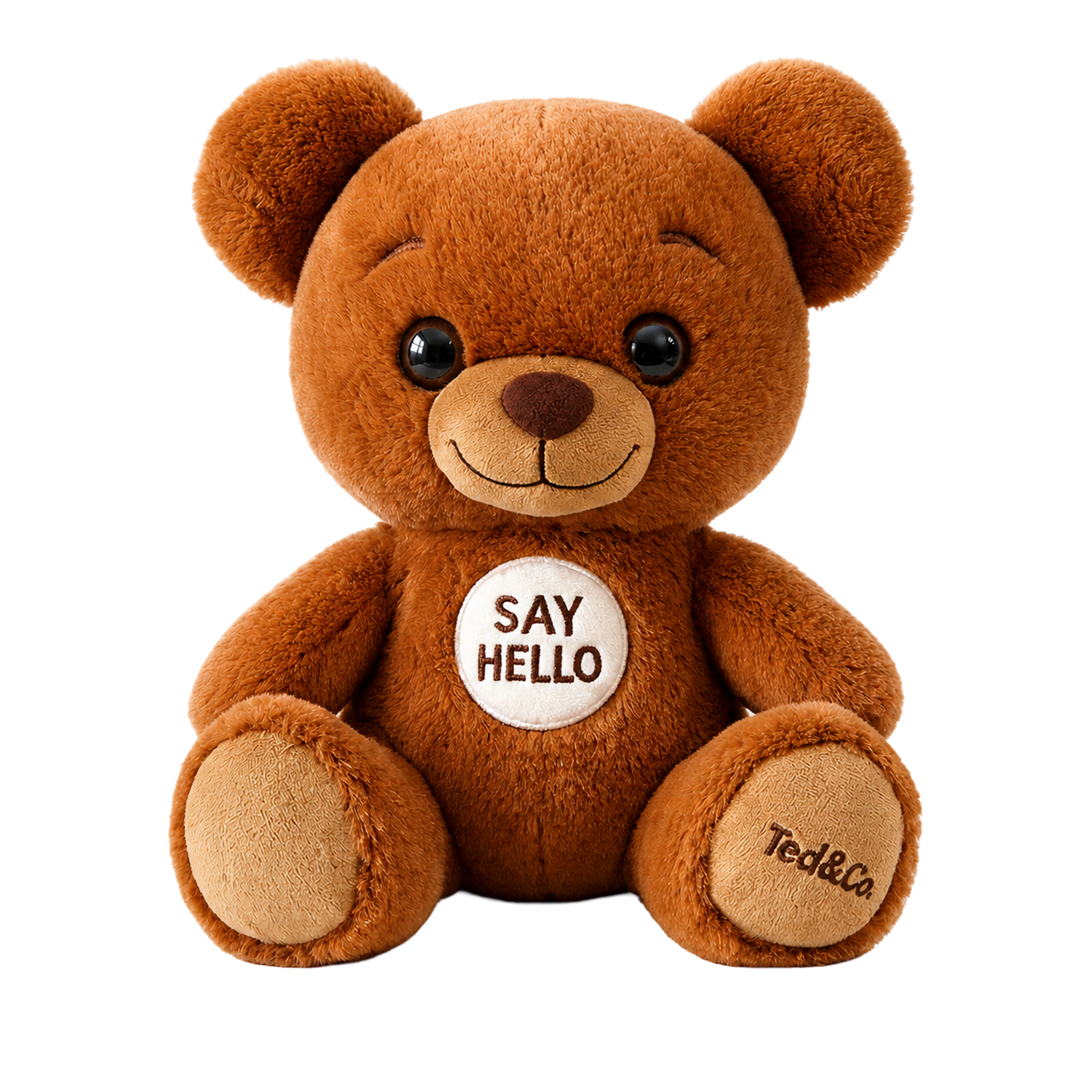
Some families use a talking plush toy to carry the story on the nights when a parent cannot. Ted, our interactive plush, builds stories around a child's name and the topics a parent has set in the app, works without a screen and without a subscription, and costs 129,00 euros as a one-time purchase. It is worth being clear about the role: it covers a night, it does not replace the parent-led routine that the research above is actually about. You can see how it works at tedco.ai.
Frequently asked questions
At what age do personalized stories start working?
Around three, which is when the self-reference memory advantage is reliably measurable and when a child can follow a story with themselves as the character. Before that, the routine still helps, but the personalization does not add much.
Is a personalized story better than reading a book?
They do different things. A book brings richer vocabulary and illustrations. An invented story brings the self-reference advantage and the ability to fold in today's actual events. Most families alternate, and there is no evidence that one must replace the other.
Should my child be the hero every night?
Not necessarily. Some children find being the centre of every story stimulating rather than calming at bedtime. If yours winds up rather than settles, put them in a supporting role or hand the lead to a favourite character.
Does the story have to be different every night?
No, and repetition is usually a good sign. Children ask for the same story because the predictability is comforting and because knowing what comes next lets them relax rather than concentrate.
My child asks for a scary bit. Should I?
A small, quickly resolved tension is fine and often what makes a story hold together. Leave it unresolved at lights-out and you have made bedtime harder rather than easier. Resolve it inside the story, every time.